Development of a Process for the Production of Nitrite-, Nitrate-, and Salt-Reduced Raw Ham
© DIL German Institute of Food Technology e.V.
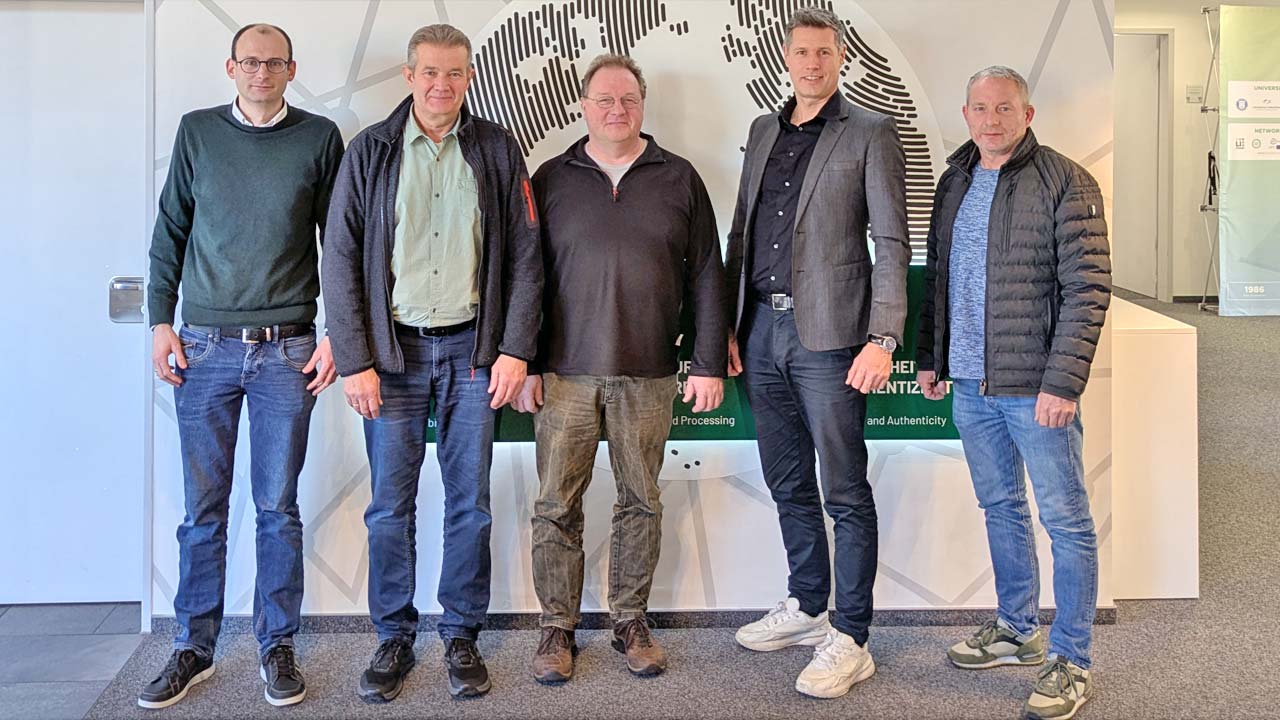
How can the high salt content of cured raw ham be significantly reduced?
Photo: From left to right: Jens Schröder, Frank Schilling, Stephan Brockfeld (all from DIL), Patrick Stamme (KLÜSTA Schinken GmbH & Co. KG), and Marco Bergmann (sb pack GmbH & Co. KG)
How can the high salt content of cured raw ham be significantly reduced? This question is now being addressed by the project “Low-Salt Raw Ham through a Combination of Processes” (abbreviated “SaRKom”), which was jointly launched by the DIL German Institute for Food Technology e. V., KLÜSTA Schinken GmbH & Co. KG, and sb pack GmbH & Co. KG. The research project is funded by NBank. There are several methods for producing raw ham: Either the meat is rubbed with curing salt and a special blend of spices (dry curing), or it is placed in a brine solution (wet curing). These processes can take up to ten weeks. However, there is also a rapid curing method known as inoculation curing, which takes only a few days. However, what all these methods have in common is that the curing process is complete once a defined amount of salt has reached the center of the ham and the ham has lost enough moisture. This is followed by drying and, if necessary, smoking, before the ham is hung to finish maturing. The end result is a product with a high salt content. However, the high use of sodium chloride (NaCl)—and curing salt in particular—in the food industry is facing increasing criticism. This is because excessive salt intake is considered a major risk factor for high blood pressure, kidney strain, and cardiovascular disease. For this reason, the research project that has now been launched focuses on the production of raw ham from pork hindquarters that contains at least 25 percent less salt and curing agents. This involves researching a new, combined processing technology for meat products, as well as the design, engineering, and construction of a facility for processing pork hindquarters. This innovative process is designed to optimize diffusion processes and achieve microbiological stability comparable to that of conventional raw ham products, despite significantly reduced levels of table salt and curing agents. For the first time, consumers will have the opportunity to choose an alternative that allows them to make more health-conscious dietary choices. If you have any questions about the project, please feel free to contact Patrick Stamme of KLÜSTA Schinken, Marco Bergmann of sb pack, or Jens Schröder of DIL, who are coordinating the project.

Link
Download