Projektstatus
Projektlaufzeit
Ansprechpartner
Laufend
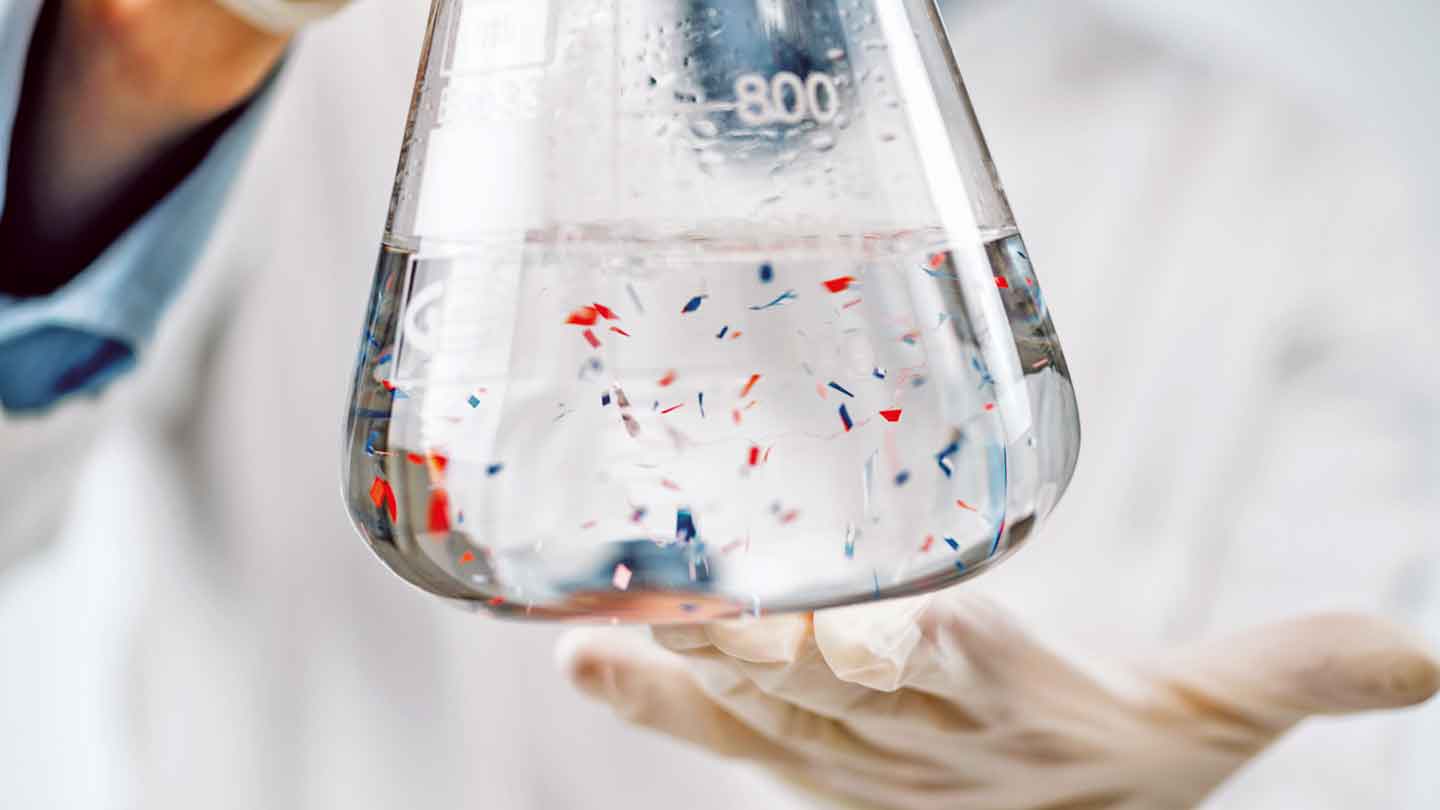
The risk of contamination from microplastics has become increasingly relevant in recent years from a societal, scientific, and regulatory perspective, and is causing growing concern. To address this issue analytically, a project was launched to develop detection strategies for microplastics in dry milk products. The goal is to develop validated methods that ensure reliable detection in complex food matrices.
The project will establish two complementary methods for microplastic analysis in food: TED-GC/MS for mass-based polymer quantification via pyrolysis and marker fragments, and Raman microscopy for image-based identification of individual particles based on their spectra. This allows not only the polymer content but also particle characteristics such as size, shape, and color to be determined, and potential sources of contamination to be identified. Technical requirements were defined for both methods, and a workflow for filtering liquid samples was established. Tests with microplastic reference standards provided initial limits of detection and quantification for TED-GC/MS; the standards were also incorporated into a Raman database. Planned recovery tests are intended to strengthen validation and improve performance in real samples. Since food matrices contain proteins, fats, and sugars, suitable extraction strategies are evaluated, matrix-particle interactions are investigated, and a method for enriching samples with expected low concentrations is developed. Contamination control (cleanroom, laminar flow, blank samples) is a top priority and provides a robust foundation for industrial applications and other matrices.



DIL German Institute of Food Technologies
Prof.-von-Klitzing-Str. 7
49610 Quakenbrück
+49 (0) 54 31 183 - 0
info@dil-ev.de
An Overview of Our Services
Consulting
Contract Manufacturing
Our Research at a Glance
Safety / Authenticity
Sustainability
Partnerships